How can an organization become faster without constantly reinventing itself?
How do you maintain orientation when numerous stakeholders, competing priorities, and complex decision paths slow everything down?
And what happens when change is not treated as a project, but as a shared learning journey?
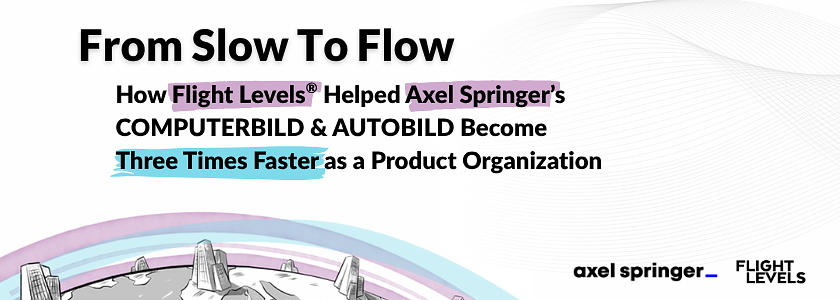
In this episode of Inside Flight Levels, Dr. Klaus Leopold (Creator of Flight Levels®) and Markus Brandl (Co-Founder of Flight Levels®) talk with Stephan Obbeck, Agile Coach at Axel Springer, about the practical application of Flight Levels at AUTO BILD and COMPUTER BILD.
The starting point was a familiar challenge in many large organizations: everything is important, everything has priority one — and in the end, it takes 338 days to deliver. Together with the teams, Stephan Obbeck made the end-to-end value streams visible, identified decision bottlenecks, and established Flight Level 2 as a coordination and steering layer. The result: 58 days lead time — and a far more resilient way of working.
In this episode, we explore:
• why the real problem wasn’t in the teams, but at the coordination level
• how Flight Levels helps make value creation visible across departments and organizational boundaries
• why Discovery Sprints proved to be an effective way to reduce upstream chaos before development
• how stable working processes increase organizational resilience — even in times of major disruption
• why re-organizations often do more harm than good, and what it really means to improve value streams instead of structures
Stephan also shares his key learnings from the case: clear goals instead of buzzwords, simplicity over framework overload — and above all, changing with people, not for them.
An honest, hands-on episode about continuous improvement, orientation in complex systems, and what it truly takes to make organizations adaptable.